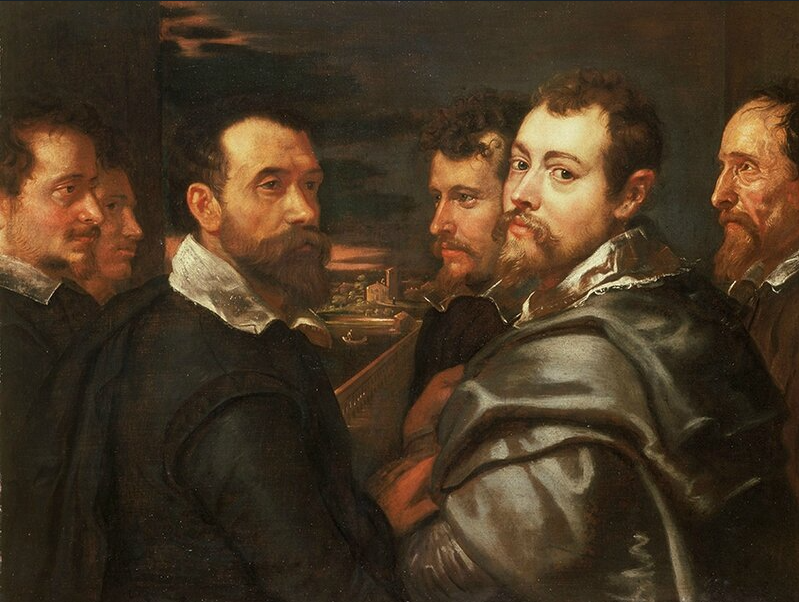
Painted between 1602 and 1604 during Peter Paul Rubens’s pivotal appointment as court painter to Vincenzo I Gonzaga, Duke of Mantua, Self-Portrait in a Circle of Friends from Mantua stands as one of the most intellectually compelling early group portraits of the Baroque era. The composition gathers six figures tied to the circle of the great Flemish Neo-Stoic philosopher Justus Lipsius. Standing prominently on the far right, a twenty-five-year-old Rubens gazes directly at the viewer alongside his scholar brother Philip Rubens, Lipsius himself, and fellow Humanist intellectuals (including Guillaume Richardot and Jan Woverius). Set against a dusky Venetian landscape at sunset, the group embodies the Renaissance ideal of amicitia—intellectual friendship grounded in shared philosophical virtue and classical learning.
Recreating Atmospheric Dusk Light, Crisp Ruff Collars, and Deep Chiaroscuro
Translating Rubens’s balanced horizontal composition ($78 \times 101\text{ cm}$) into an authentic oil reproduction demands extraordinary technical skill in subtle portraiture, soft edge painting, and atmospheric lighting. Our master studio artists build up translucent layers of charcoal black, deep umber, burnt sienna, and warm sunset-gold glazes. Special focus is dedicated to capturing the dramatic visual contrasts: the crisp, starched white ruff collars framed against dark black cloaks, the varied individual expressions across the six intellectual companions, and the soft directional glow illuminating Rubens’s youthful, confident face against the shadowy background.
Framing and Interior Styling Suggestions
With its versatile horizontal proportions ($78 \times 101\text{ cm}$) and dark, scholarly color palette, Self-Portrait in a Circle of Friends from Mantua serves as an engaging, sophisticated focal point for fine traditional and transitional interior settings.
-
Wall Palette: Pairs exceptionally well with warm beige, rich cream, deep burgundy, dark olive green, or classic dark wood-paneled feature walls.
-
Atmosphere: Ideal for executive studies, private home libraries, writing alcoves, office gallery walls, or curated collections of 17th-century European art.
-
Framing Options: An ornate carved Flemish black-and-gold frame underscores its Northern Renaissance heritage, while a dark mahogany or walnut wood frame offers a grounded, classical presentation.





Reviews
There are no reviews yet.