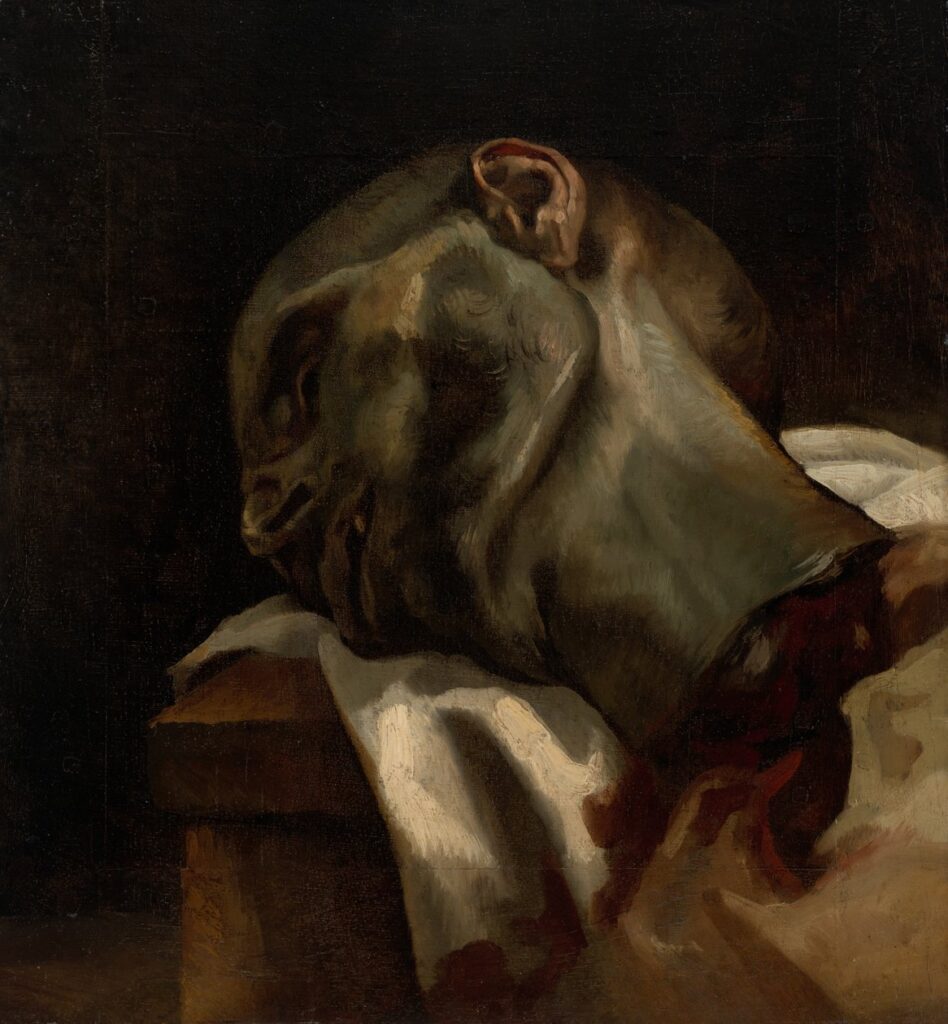

Painted between 1818 and 1819 in preparation for his legendary masterpiece The Raft of the Medusa (Le Radeau de la Méduse), Théodore Géricault’s Head of a Guillotined Man (Tête de supplicié) stands as one of the most haunting and influential anatomical studies in European art history. Housed in the National Gallery in London, this work demonstrates Géricault’s commitment to unvarnished truth. To render the grim reality of suffering and death on his monumental canvas, the artist secured severed limbs and guillotined heads from the Beaujon Hospital and Paris morgue to study in his studio. Far from mere morbid curiosity, Géricault elevated these anatomical studies into profound meditations on human mortality, dignity in death, and the fragile line between life and oblivion that defined early French Romanticism.
Studio Craftsmanship and Chiaroscuro Precision
Recreating Géricault’s masterful handling of shadow, pallid skin tones, and subtle impasto requires extraordinary technical skill and anatomical understanding. Studio painters carefully layer deep charcoal blacks, cold slate greys, and earthy umbers to build the brooding chiaroscuro background. Against this darkness, translucent glazes of pale alabaster, sickly yellow, and muted ochre bring the severed head’s quiet, frozen countenance into stark relief. Special attention is devoted to capturing the subtle weight of relaxed features, the fine texture of hair, and the solemn light that imbues this morbid subject with an unmistakable classical nobility and museum-grade depth.
Styling Your Interior Space
The dramatic chiaroscuro contrast, deep monochromatic earth tones, and monumental historical importance of Head of a Guillotined Man make it a powerful statement piece for private executive libraries, academic studies, or curated high-art gallery displays. The artwork pairs exceptionally with dark walnut or ebony furniture, vintage bronze sculptures, antique leather bindings, and soft neutral, dark charcoal, or deep olive wall palettes, instilling an atmosphere of intense intellectual rigor, historical depth, and uncompromising artistic courage.
Key Details
-
Artwork Title: Head of a Guillotined Man (Kopf eines guillotinierten Mannes / Tête de supplicié / c. 1818–1819)
-
Original Artist: Jean-Louis-André-Théodore Géricault (1791–1824)
-
Art Movement: French Romanticism / Anatomical Realism
-
Production Method: 100% Hand-Painted Oil Reproduction
-
Base Material: Canvas




Reviews
There are no reviews yet.