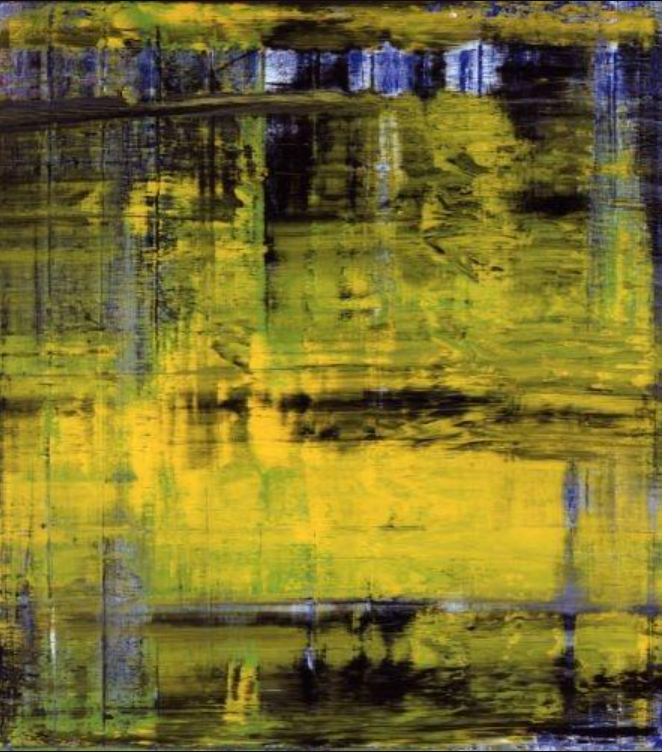
Painted in 1994, Abstraktes Bild belongs to Gerhard Richter’s celebrated abstract series, which he developed from the late 1960s onward. Working with a large squeegee tool, Richter dragged wet paint across the canvas in broad, directional sweeps. Each pass buried earlier layers and exposed fragments of others, producing a surface where nothing reads as a fixed final image. The composition has no single focal point; the eye moves across overlapping bands, scumbled edges and rubbed-through patches, reading the painting as a record of process rather than a designed scene.
Colour, Light and the Unfinished Surface
Richter’s palette here is muted and earth-leaning: off-whites, greys, ochre, black and passages of deeper colour visible beneath the scraped skin. Because the squeegee thins and shifts paint, light does not sit on the surface but seems to move within it — some passages look opaque, others almost transparent. There is no conventional chiaroscuro, yet tonal depth keeps shifting as you change position. The mood is quiet, contemplative and deliberately unresolved. Richter once described these abstracts as a way of withholding meaning, and that openness is part of their effect.
What Our Painters Focus On
This is a hand-painted oil reproduction, not the original artwork at Tate Modern. The hardest part of interpreting this series is not drawing a motif but reproducing the behaviour of dragged and scraped paint. Our painters work in layered passes, building up wet pigment and then pulling across it, leaving the irregular streaks and ghosted underlayers that define the original. We avoid flattening the surface into a uniform printed pattern, and we do not over-neat the edges. Each hand-painted canvas carries minor natural variations in stroke and colour blending, which is inherent to handcraft and distinguishes it from flat printed reproductions.
Display Suggestions
Because the original is very large, it works best as a statement piece on a single clear wall rather than competing with other pictures. Neutral walls — off-white, warm grey or pale concrete — let the muted colour fields breathe. It pairs naturally with minimalist, modernist or gallery-style interiors. Even, diffuse lighting is preferable to strong directional spots, which can flatten the layered surface. We recommend measuring your wall carefully before selecting your display size. (Word count: 428)
Key Details
- Hand-painted oil reproduction, not the original artwork
- Interprets Abstract Picture (Abstraktes Bild), painted in 1994
- Style: Abstract Expressionism; Genre: abstract
- Medium: oil on canvas
- Original size: 225 x 220 cm; Original collection: Tate Modern, London, UK
- Created by artists from Dafen artist studio


Reviews
There are no reviews yet.