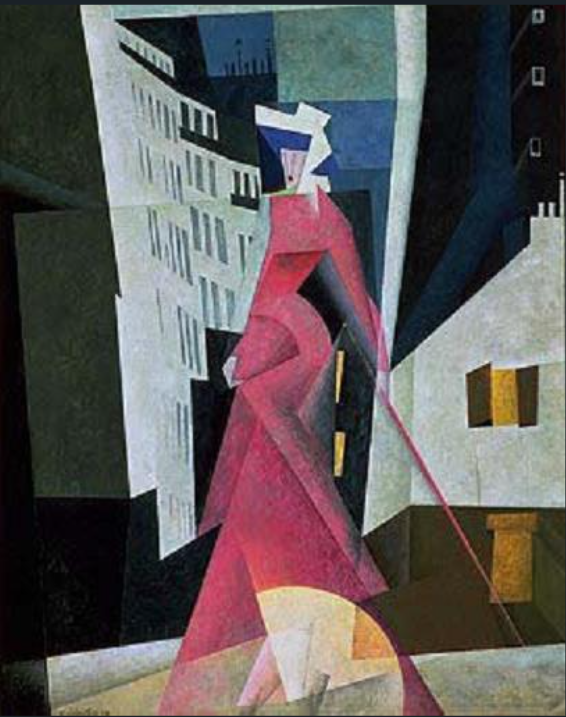
The composition centres on a seated woman, rendered not as a naturalistic portrait but as an assembly of tilted, overlapping prismatic shapes. Feininger fractures the figure and her surrounding space into geometric segments, applying the same crystalline language he commonly used for architecture and seascapes to a human subject. Gentle lines define her posture and drapery; multiple viewpoints are woven together, prioritising formal rhythm over realistic likeness.
Light, Colour & Reproduction Brushwork
Mauve and lavender tones dominate the figure’s garment, balanced with pale grey, slate blue and faint warm ochre accents. Semi-transparent colour blocks overlap, allowing planes to layer and breathe without heavy shadow. When creating this hand-painted oil reproduction, our artists retain the precise linear divisions, subtle tonal transitions and quiet introspective mood of the original canvas.
Art Historical Context
Completed in 1922 during Feininger’s Bauhaus years, Lady in Mauve is one of his less frequent figurative Cubist paintings. At this stage, he had fully refined his unique brand of Cubism, characterised by luminous, glass-like fractured forms. While he is far better known for churches, bridges and coastal scenes, this piece demonstrates his ability to apply his geometric vision to portraiture.
Display and Styling Guidance
This refined Cubist portrait suits minimalist gallery walls, elegant reading rooms, modern office spaces and curated Cubism figurative collections. A slim matte black or light walnut frame complements its clean linear structure and soft palette. It pairs beautifully with off-white, light grey and dusty lavender walls and can be grouped alongside other Lyonel Feininger reproductions.
Key Details
- Artist: Lyonel Feininger
- Artwork: Lady in Mauve
- Date: 1922
- Style: Cubism
- Genre: genre painting
- Original medium: oil on canvas
- Location: Thyssen-Bornemisza Museum, Madrid, Spain
- Product type: hand-painted oil reproduction




Reviews
There are no reviews yet.