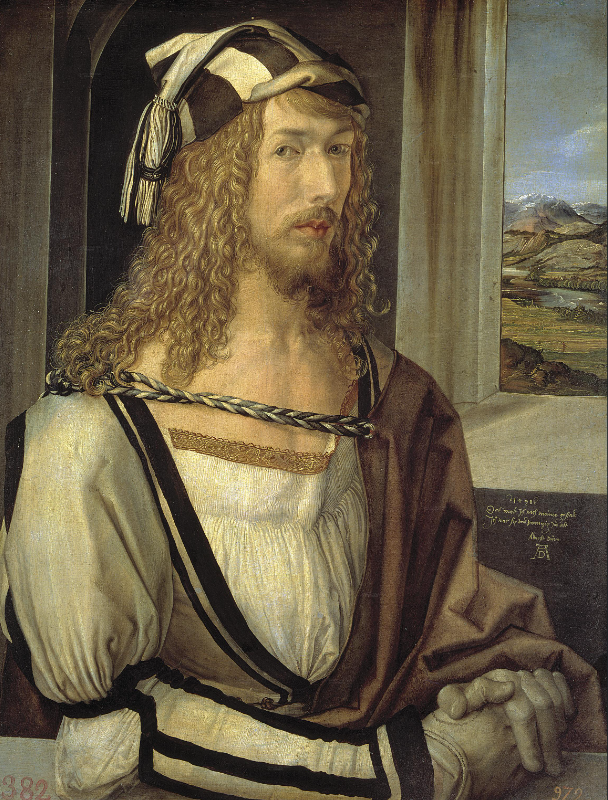
Albrecht Dürer’s famous 1498 Self-Portrait, housed in the Museo del Prado, marks a transformative moment in Western art history where the artist presents himself not as a humble craftsman, but as a dignified, fashionable gentleman of noble standing. Posed comfortably in a half-length three-quarter view indoors beside an open window, Dürer wears an opulent white tunic trimmed with gold braid, a tasselled cap, and finely fitted kidskin gloves. Through this regal presentation and the serene alpine landscape visible in the background, Dürer asserts the elevated intellectual status of the painter during the High Renaissance.
Studio Craftsmanship and Color Relationships
Translating this icon of Renaissance portraiture onto canvas demands exceptional accuracy in linear detail, textile rendering, and atmospheric light. Studio painters carefully replicate the crisp contrast between the bright white garments, warm golden braids, and rich dark mantle. Delicate brushwork is used to depict the fine ringlets of Dürer’s golden-brown hair, the soft leather texture of his gloves, and the subtle tonal gradations across the distant mountain ranges framed by the window casing.
Styling Your Interior Space
The stately posture, rich historical attire, and balanced interior-to-landscape composition make this 1498 self-portrait an outstanding centerpiece for executive studies, formal sitting rooms, or traditional home libraries. It pairs naturally with rich mahogany or walnut furniture, brass fixtures, and dark neutral or jewel-toned wall palettes, imbuing the room with an aura of Renaissance intellect and timeless refinement.
Key Details
-
Artwork Title: Self-Portrait (1498)
-
Original Artist: Albrecht Dürer
-
Art Movement: Northern Renaissance
-
Production Method: 100% Hand-Painted Oil Reproduction
-
Base Material: Canvas



Reviews
There are no reviews yet.