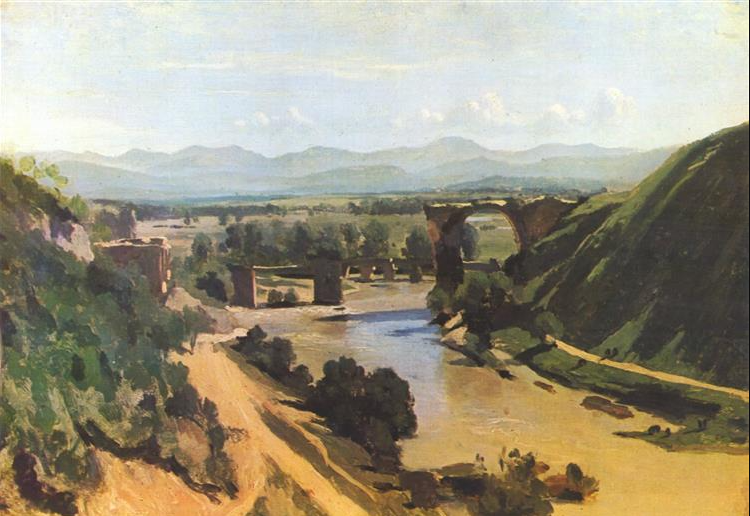
Painted in September 1826 during Corot’s first trip to Italy, The Bridge at Narni (Le Pont de Narni) stands as one of the most seminal open-air studies in the history of Western landscape art. Housed in the Musée du Louvre, this legendary study was executed directly on-site in the Umbrian countryside over just a few sessions. Corot was mesmerized by the dramatic ruins of the ancient Roman Augustus Bridge framing the Nera River. Moving away from the heavily stylized, studio-bound Neoclassical conventions of his day, Corot focused on pure tonal relationships (valeurs) and the brilliant, clarifying effect of Mediterranean sunlight on stone and soil, effectively bridging classical Italian tradition and the modern Impressionist revolution that followed.
Studio Craftsmanship and Italianate Golden Light
Recreating Camille Corot’s 1826 Italian masterwork demands exceptional discipline in structural clarity and nuanced color gradation. Master artists at Dafen Village Studio systematically layer premium oil paints on high-grade canvas, carefully balancing sun-bleached terracotta ochres, warm alabaster stone, earthy olive greens, and delicate azure skies framed by soft golden light. By emulating Corot’s confident, block-like paint application across the ruined archways alongside his subtle, silvery atmospheric glazes over the distant hills, this hand-painted studio reproduction captures the serene architectural dignity, sunlit airiness, and museum-grade prestige of the original Louvre canvas.
Styling Your Interior Space
The pristine horizontal landscape composition, warm Mediterranean color palette, and prestigious Louvre lineage make The Bridge at Narni an exceptional statement piece for executive libraries, classic reception rooms, master bedroom suites, or formal dining spaces. The artwork pairs naturally with antiqued gold leaf, French champagne, or classic dark walnut and carved mahogany frames, rich leather or velvet upholstery, brass fixtures, and soft neutral, warm ivory, pale terracotta, or French slate wall palettes, filling your living environment with an aura of scholarly sophistication, classical Italianate majesty, and French fine art heritage.
Key Details
-
Artwork Title: The Bridge at Narni (1826) / Le Pont de Narni
-
Original Artist: Jean-Baptiste-Camille Corot (1796–1875)
-
Art Movement: Realism / Neoclassical Plein-Air Landscape / Pre-Impressionism
-
Production Method: 100% Hand-Painted Oil Reproduction
-
Base Material: Canvas
-
Original Dimensions: 34 x 48 cm
-
Current Location: Musée du Louvre, Paris, France




Reviews
There are no reviews yet.