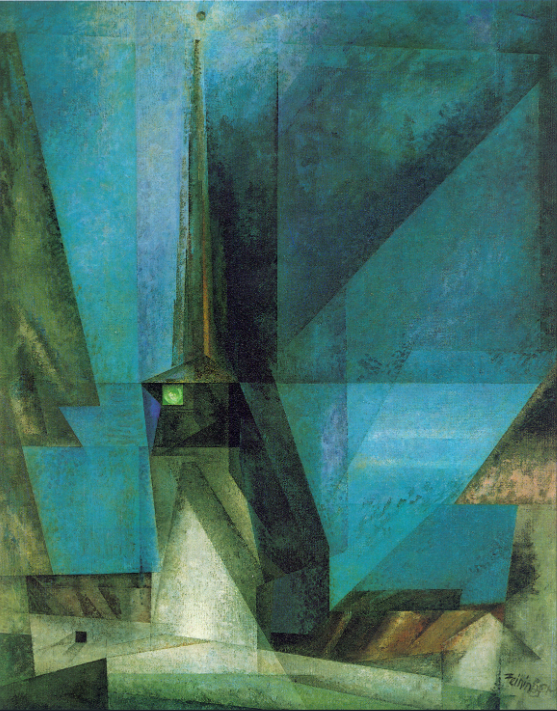



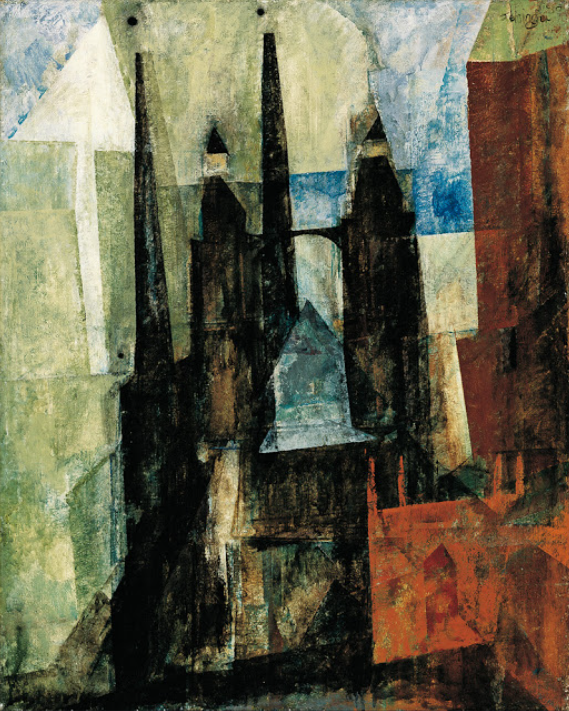
The painting features the village church at Gelmeroda, one of Feininger’s most enduring and revisited motifs. He disassembles the steeple, roof and surrounding buildings into tilted, faceted geometric planes. Multiple viewpoints merge within a single frame, abandoning conventional perspective. Lines slice and segment the forms to create a shimmering, airy structure. The church stands as a luminous, almost otherworldly landmark rather than a literal architectural record.
Light, Colour & Reproduction Brushwork
Muted slate blues, soft greys, pale ochres and restrained earth tones form the palette. Semi-transparent colour blocks overlap, letting underlying planes show through and building delicate depth without heavy shadow. When creating this hand-painted oil reproduction, our artists retain the precise angular divisions, clean linear rhythm and quiet spiritual mood of the original canvas.
Art Historical Context
Painted in 1936, this is the thirteenth version in Feininger’s long-running Gelmeroda series. By this time, he had perfected his personal crystalline Cubist style. He returned repeatedly to this small village church, exploring new geometric arrangements and colour harmonies across decades. This version is held in the Met’s collection.
Display and Styling Guidance
This classic Cubist architectural painting fits wonderfully in minimalist galleries, architect studios, modern reading rooms and curated Cubism collections. A slim matte black or light walnut frame complements its crisp graphic structure. It pairs beautifully with off-white, light grey and soft charcoal walls and can be grouped alongside other Lyonel Feininger church reproductions.
Key Details
- Artist: Lyonel Feininger
- Artwork: Gelmeroda XIII
- Date: 1936
- Style: Cubism
- Genre: cityscape
- Original medium: oil on canvas
- Location: Metropolitan Museum of Art (Met), New York City, NY, US
- Product type: hand-painted oil reproduction




Reviews
There are no reviews yet.