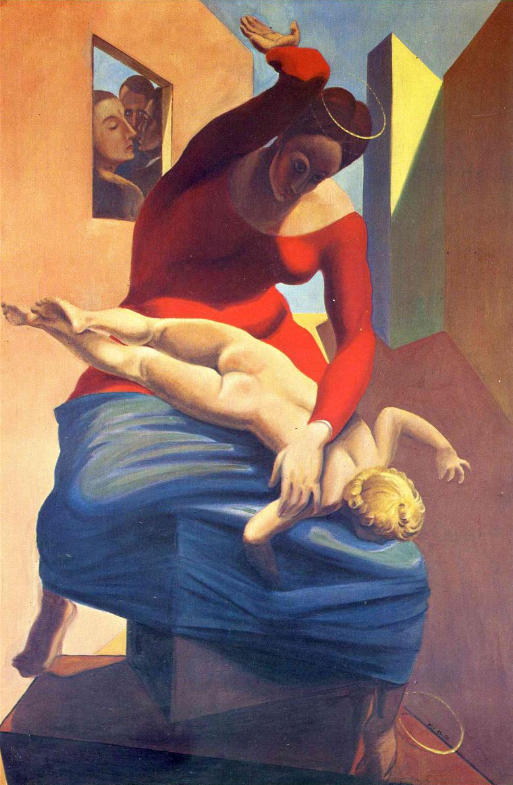
Completed in 1926 in Paris, this landmark work belongs to Max Ernst’s first French surrealist period. The central action unfolds in a sparse, geometric architectural interior. The main figures are arranged in the foreground, with the three witnesses positioned to the side as immobile, statue-like presences. Visual rhythm relies on rigid vertical forms, clean dividing lines and the frozen quality of every pose. There is no dramatic movement; the scandalous scene is staged with the quiet, suspended stillness inherited from de Chirico’s metaphysical painting.
Palette, Light and Understated Mood
The palette uses restrained stone and neutral tones: pale plaster white, muted beige, ash grey and deep reserved shadows. Light is even, clear and artificially staged, casting sharp shadows without warm baroque glow. Colours serve to emphasise form rather than sentiment. The mood is mysterious, disquieting and poetic. It strips religious painting of piety, replacing reverence with the strange, unresolvable logic of the unconscious dream.
Hand-Painted Interpretation Focus Points
This is a hand-painted oil reproduction, not the original work preserved at Museum Ludwig, Cologne. Our painters faithfully reproduce the crisp outlines, flat architectural planes and statuesque stillness of all figures. We retain the dry, matte surface and avoid soft, sentimental blending or dramatic chiaroscuro. Each hand-painted canvas carries minor natural variations in stroke and colour blending, which distinguishes handcrafted oil painting from flat printed reproductions.
Interior Styling Suggestions
This controversial surrealist masterpiece suits gallery, art studio and modernist display spaces. A simple slim dark frame keeps focus on the painting’s layered symbolism. It is best exhibited individually or grouped carefully with other early surrealist works. Calm, neutral ambient lighting preserves the cool, static quality of the interior stage. We recommend measuring your wall carefully before selecting your display size. (Word count: 427)
Key Details
- Hand-painted oil reproduction, not the original artwork
- Interprets The Virgin Spanking the Christ Child before Three Witnesses: Andre Breton, Paul Eluard, and the Painter, painted in 1926, Paris France, Surrealism symbolic painting
- Medium: oil on canvas
- Original size: 196 x 130 cm, Original collection: Museum Ludwig, Cologne
- Created by artists from Dafen artist studio




Reviews
There are no reviews yet.