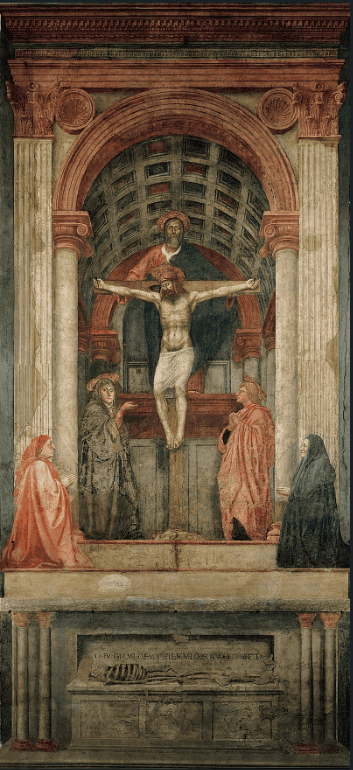
Masaccio constructs the illusion of a deep stone vault recess embedded within the church wall. God the Father, the Son and the Holy Spirit occupy the centre of this fictive chapel, flanked by the Virgin Mary, Saint John and two kneeling donors. The carefully calculated linear perspective creates a convincing three-dimensional cavity, making the painted architecture appear to extend into the actual church space — a staggering technical breakthrough of the Early Renaissance.
Light, Colour & Reproduction Brushwork
Directional, consistent light defines every architectural edge and figure with measured shadow and volume. The palette is restrained and reverent: muted stone tones, somber robes and gentle flesh tones dominate. When creating this hand-painted oil reproduction, our artists retain the precise perspective geometry and soft tonal gradations that give the fresco its awe-inspiring spatial illusion.
Art Historical Context
Completed between 1427 and 1428, The Holy Trinity stands as one of Masaccio’s most influential works. This fresco systematically demonstrates linear perspective for viewers and subsequent artists. The trompe-l’œil illusion shaped how painters imagined space for centuries. The original fresco remains in Santa Maria Novella, Florence.
Display and Styling Guidance
This monumental religious work suits large chapel spaces, grand entrance gallery walls and curated collections of foundational Renaissance masterpieces. A substantial dark wood frame complements its majestic, contemplative character. It pairs beautifully with off-white, warm stone grey or soft taupe walls and can be grouped with other Masaccio reproductions from the Brancacci Chapel cycle.
Key Details
- Artist: Masaccio
- Artwork: The Holy Trinity
- Date: 1427 – 1428
- Style: Early Renaissance
- Genre: religious painting, trompe-l’œil
- Original medium: fresco
- Location: Santa Maria Novella, Florence, Italy
- Dimensions: 667 x 317 cm
- Product type: hand-painted oil reproduction




Reviews
There are no reviews yet.