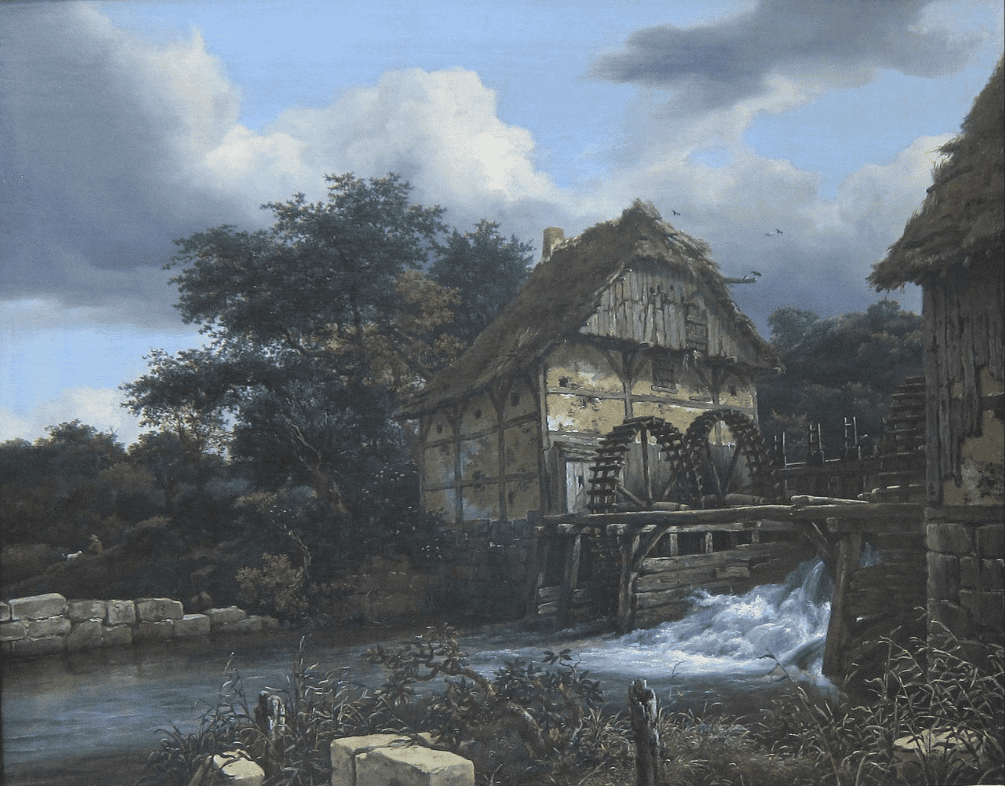
The watermills occupy the midground, the sturdy wooden wheels positioned in the churning stream. The open sluice channels the current, creating ripples and bright highlights across the water surface. Thick trees and tangled undergrowth frame the scene, while a soft cloudy sky stretches overhead. The palette leans into rich earth tones: deep forest green, weathered brown, cool grey water, and pale silvery sky. Contrast between shadow and sunlight brings texture and vitality to every element.
Hand-Painted Interpretation Details
Our hand-painted oil reproduction carefully reproduces the rough grain of mill timber, the shimmer and movement of rushing water, and the dense foliage of the surrounding woods. Our artisans preserve the immersive, lively atmosphere and balanced tonal structure of van Ruisdael’s original canvas. This is a hand-painted interpretation, not the original artwork, authorized edition or museum-certified piece.
Styling & Placement Suggestions
This narrative Baroque landscape fits traditional studies, farmhouse dining rooms, rustic entryways and Old Master painting collections. It pairs wonderfully with dark oak antique frames, classic country furnishings and wall colours such as warm cream, taupe and muted sage. It brings a vivid, storytelling pastoral charm to classic and transitional interiors.
Artistic Context
Completed in 1653, this canvas is one of Jacob van Ruisdael’s iconic watermill scenes. Watermills were vital infrastructure in the Dutch Golden Age, powering grain milling and local trade. Van Ruisdael transformed these functional industrial sites into poetic landscape subjects, balancing precise observation of mechanics and nature. The original work is held at the J. Paul Getty Museum, Los Angeles.
Key Details
- Artist: Jacob van Ruisdael
- Artwork: Two Watermills and an Open Sluice
- Date:1653
- Style: Baroque, Dutch Golden Age
- Genre: landscape
- Media: oil, canvas
- Location: J. Paul Getty Museum, Los Angeles, CA, US




Reviews
There are no reviews yet.