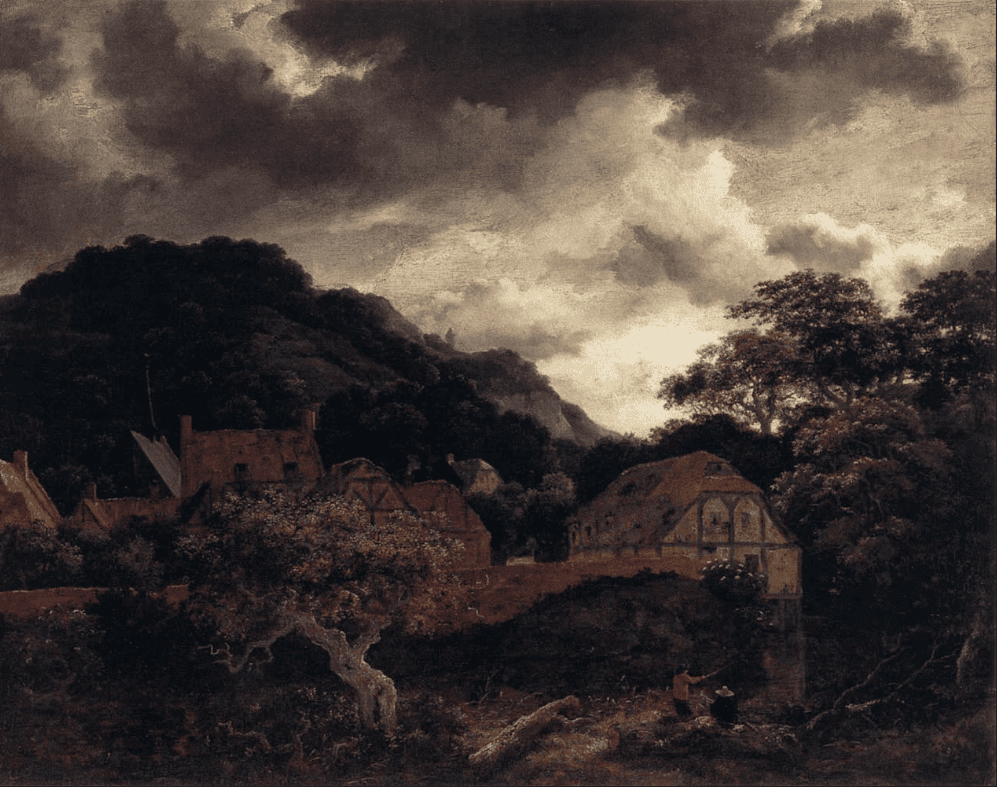
Tall, shadowy trees line one side of the canvas, creating a strong natural frame. The village buildings spread gently across the midground, with faint paths and small figures scattered throughout the open terrain. The colour palette is subdued and natural: deep forest green, weathered brown, muted grey, warm ochre and a pale, hazy sky. Gentle shifts in light and shadow build atmospheric depth, a signature trait of van Ruisdael’s landscape craft.
Hand-Painted Interpretation Details
Our hand-painted oil reproduction faithfully reproduces the weight of the forest edge, the soft haze of the countryside and the quiet, unhurried mood of the original. Our painters carefully render tree textures, rustic architecture and subtle tonal transitions. This is a hand-painted interpretation, not the original artwork, authorized edition or museum-certified piece.
Styling & Placement Suggestions
This classic Baroque landscape suits traditional libraries, farmhouse living rooms, formal hallways and old master painting collections. It pairs wonderfully with dark antique wooden frames, classic furnishings and wall colours such as cream, warm taupe and muted grey. It brings serene, timeless pastoral atmosphere to classic and transitional interiors.
Artistic Context
Completed in 1651, Village at the Wood’s Edge is a representative work of the Dutch Golden Age. Jacob van Ruisdael excelled at capturing the quiet drama of ordinary rural scenery. Rather than dramatic mythological scenes, he focused on the meeting point of forest and settlement, celebrating the humble beauty of local Dutch landscapes. The original work is preserved at Gemäldegalerie, Berlin.
Key Details
- Artist: Jacob van Ruisdael
- Artwork: Village at the Wood’s Edge
- Date:1651
- Style: Baroque, Dutch Golden Age
- Genre: landscape
- Location: Gemäldegalerie, Berlin, Germany




Reviews
There are no reviews yet.